Democracy's Insurance Policy: Why Protecting Your Political Enemies Keeps Nations Alive
The Mathematics of Survival
Every civilization faces the same fundamental equation: what to do with the people who say you're wrong. The arithmetic is deceptively simple, but five thousand years of human experience reveal that most societies fail this basic calculation. They confuse the messenger with the message, the critic with the enemy, and in doing so, they eliminate their own early warning systems.
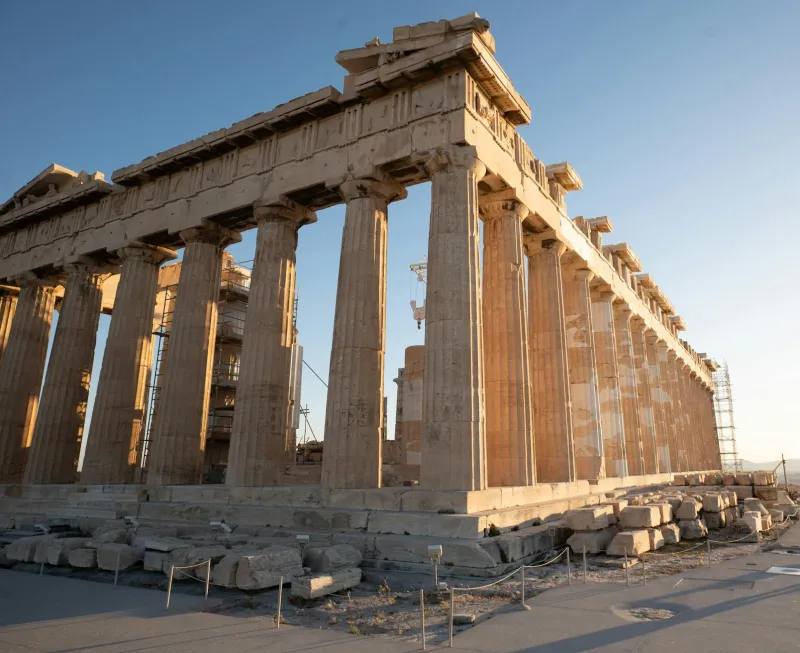
The Athenians understood this better than most. Their invention of ostracism—the annual vote to exile one prominent citizen for ten years—wasn't cruelty disguised as democracy. It was a pressure release valve that removed dangerous personalities without killing them, preserving both social stability and the possibility of their return when circumstances changed. Aristides the Just was ostracized in 482 BCE, only to be recalled when Xerxes invaded. The system worked because it separated the person from their ideas, allowing Athens to benefit from both.
Contrast this with Sparta, where criticism of the state was treated as sedition. The Spartan system produced military excellence but intellectual stagnation. When their world changed, they had no mechanism for adaptation because they had systematically eliminated the voices that might have warned them. By the time Rome conquered Greece, Athens had contributed philosophy, mathematics, and political theory to human civilization. Sparta contributed cautionary tales.
The British Breakthrough
The English stumbled onto democracy's most elegant solution almost by accident. The parliamentary system didn't emerge from enlightened theory—it grew from medieval kings who needed money and discovered that the people with money had opinions. What started as fiscal necessity evolved into something unprecedented: institutionalized opposition.
The role of "Her Majesty's Most Loyal Opposition" sounds like constitutional poetry, but it represents a profound psychological insight. By formalizing dissent, the British system transformed political enemies into political competitors. The opposition wasn't trying to destroy the state—they were trying to run it better. This subtle distinction changed everything.
When Charles James Fox opposed King George III's policies during the American Revolution, he wasn't committing treason—he was performing his constitutional duty. The system channeled his dissent into legislative debate rather than revolutionary plotting. The result was a political culture that could absorb massive disagreements without fracturing.
America's Radical Experiment
The American founders took this logic to its extreme conclusion. The First Amendment wasn't a feel-good gesture toward free expression—it was structural engineering. They had studied enough history to understand that governments inevitably expand their definition of dangerous speech until it includes any criticism at all.
James Madison's insight was mathematical: if you want to preserve the ability to criticize the government when it actually goes wrong, you must protect the right to criticize it when it's doing nothing wrong at all. The amendment protects not just political dissent but blasphemy, obscenity, and what Madison called "licentious" speech because the alternative—letting officials decide which criticism is legitimate—inevitably leads to the elimination of all criticism.
This wasn't idealism. It was cold pragmatism based on historical observation. Every society that granted itself the power to silence "dangerous" speech eventually used that power to silence inconvenient truth.
The Pattern of Collapse
History's failed democracies follow a depressingly consistent script. First, they identify a crisis that justifies extraordinary measures. Then they expand the definition of who constitutes a threat to public order. Finally, they discover that eliminating political opposition doesn't solve problems—it just eliminates the people who point out that problems exist.
Weimar Germany provides the textbook example. The republic's final years were marked by increasingly broad definitions of sedition and treason. Political parties were banned, newspapers shuttered, and dissidents imprisoned—all in the name of preserving democratic order. By the time Hitler took power, German democracy had already dismantled its own immune system.
Similar patterns emerged in Chile before Pinochet, in Venezuela before Chávez, and in countless other societies that confused stability with stagnation. They all made the same fatal error: they treated the symptoms of political dysfunction rather than its causes, silencing critics instead of addressing the problems critics identified.
The Infrastructure of Dissent
Functional democracies don't just tolerate opposition—they institutionalize it. They create formal roles for critics, legal protections for dissent, and cultural norms that celebrate rather than suppress disagreement. This isn't philosophical luxury—it's practical necessity.
Opposition parties, independent courts, free press, and protected speech aren't separate features of democratic government—they're components of a single system designed to process conflict without violence. Remove any one element, and the entire mechanism begins to fail.
The American Test
Today's America faces the same historical test that every democracy eventually confronts: will it treat political opposition as a legitimate part of governance or as an existential threat to be eliminated? The answer will determine whether American democracy joins the ranks of durable self-governing societies or becomes another cautionary tale in history's long record of civilizations that chose temporary order over permanent freedom.
The choice isn't between stability and chaos—it's between the controlled chaos of democratic debate and the uncontrolled chaos that inevitably follows when societies eliminate their capacity for peaceful change. Five thousand years of human experience suggest there is no middle ground.