The Sophomore Sample: How Modern Science Shrank Humanity to a 19-Year-Old With Free Time
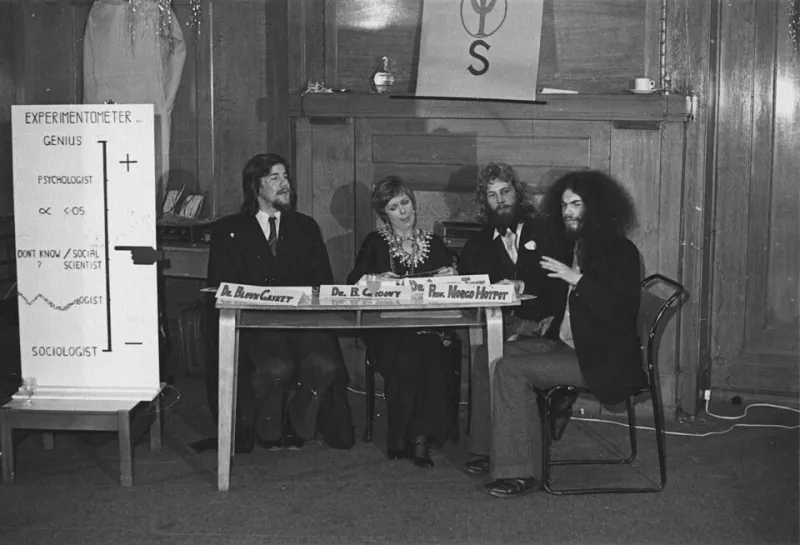
Photo: Unknown, No restrictions, via Wikimedia Commons
There is a database larger than any laboratory has ever assembled. It contains roughly five thousand years of continuous observation of the human species: marriages, betrayals, market panics, revolutions, and the mundane daily decisions of billions of people who left behind ledgers, letters, court transcripts, and receipts. It is unstructured, unstandardized, and unglamorous. And for most of the twentieth century, the people studying human behavior decided they didn't need it.
TheWEIRDESTDatasetonEarth
In 2010, researchers Joseph Henrich, Steven Heine, and Ara Norenzayan published a paper that should have been a bigger scandal than it was. They surveyed the top journals in psychology and found that the overwhelming majority of human subjects came from Western, educated, industrialized, rich, democratic societies — a population representing roughly twelve percent of humanity. Dig deeper and it gets narrower: a large share were college students. In some subfields, two-thirds of the samples were American undergraduates.
The authors coined the acronym WEIRD, and the irony was intentional. These were, by nearly every measurable trait — individualism, risk tolerance, fairness intuitions, spatial reasoning — statistical outliers among the world's populations. Yet the field generalized from them freely, titling papers things like "How Common Goods Resolve Social Dilemmas" as though a dormitory full of sophomores earning course credit constituted the species.
What Happened When the Tests Ran Again
The reckoning arrived in 2015, when the Open Science Collaboration attempted to replicate one hundred prominent psychology studies. Fewer than half held. Ego depletion wobbled. Power posing, once a TED-talk staple, dissolved under scrutiny. The famous facial feedback effect — the idea that holding a pen in your mouth makes cartoons funnier — failed so thoroughly that its own original co-author published the failed replication himself.
Some of this was methodological: small samples, unpublished failures, statistical shortcuts. But some of it was simpler. The findings were artifacts of a narrow sample and a contrived setting. A person asked to make an economic choice for a lab hour behaves differently from a person making the same choice when their family's livelihood depends on it. The laboratory, by design, strips away the stakes. History is nothing but stakes.
The Archive Was Running Replications All Along
Here is what the deep record shows. Modern social science told us that people reliably discount the future — and the clay tablets of Old Babylonian Ur, filled with debt contracts, litigation over defaulted loans, and royal edicts cancelling obligations, documented the same temporal myopia so completely that periodic debt jubilees became standard statecraft, not a curiosity.
Social science told us that groups converge on shared beliefs under pressure and punish dissenters. The historical record documents that pattern with such regularity — from the witchcraft panics of early modern Europe to committee failures catalogued in the Pentagon Papers era — that it functions less as a finding than a recurring plot structure.
Social science told us scarcity changes decision-making. Every famine archive ever kept, including granary records from the Roman annona to the Dust Bowl, shows the same signature: shortened time horizons, riskier bets, heightened conflict over resources.
None of this diminishes the value of controlled experiments. But it does suggest the hierarchy was backwards. The archive is not a supplement to the laboratory; on questions of consequence, it is the primary dataset, and the lab is a narrow, oddly filtered sample of it.
What This Means for Anyone Reading a Headline Today
The practical stakes are not academic. When a consulting firm cites "behavioral research" to justify a policy, or a news cycle amplifies a single study about what people "really" want, it is worth asking the question the deep record forces: has this pattern ever actually held among people with something to lose, over any meaningful stretch of time?
Five thousand years of written observation is sitting in libraries, archives, and digitized collections, largely unconsulted by the people building models of human nature. It is free to access. It does not require informed consent. Its subjects were never bored, because the situations were real.
The bored sophomore will tell you what a person does for an hour in a windowless room. The archive will tell you what people do when it counts. We have spent a century privileging the first answer over the second. The replication crisis was, in a sense, the archive filing its complaint.