What We Owe Them, What We Pay Them: Five Thousand Years of Societies Confronting the Soldiers They Sent Away
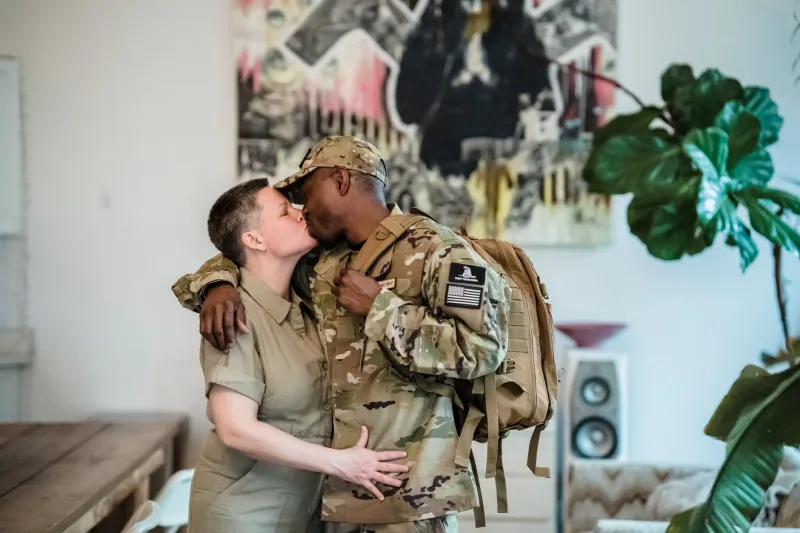
War, in the long record of human civilization, has almost always been easier to start than to finish. The armies that march out do so with ceremony, with purpose, with the full institutional weight of the state behind them. The soldiers who return — if they return — arrive into a political and economic landscape that has already moved on. Their claims are inconvenient. Their wounds are invisible or unwelcome. Their stories contradict the narrative that the society has constructed around the conflict in their absence.
This is not a modern phenomenon. It is not a product of industrial warfare, of the particular psychological stresses of counterinsurgency, or of any other feature unique to the contemporary moment. It is as old as organized armies, and the record of how different civilizations have handled it tells us something essential about those civilizations — something that no amount of official rhetoric can revise.
Rome's Broken Contract and the Republic's End
The transformation of the Roman Republic into the Roman Empire is one of history's most analyzed political transitions, and it has many causes. Near the top of any honest accounting, however, sits the treatment of the Roman legionnaire.
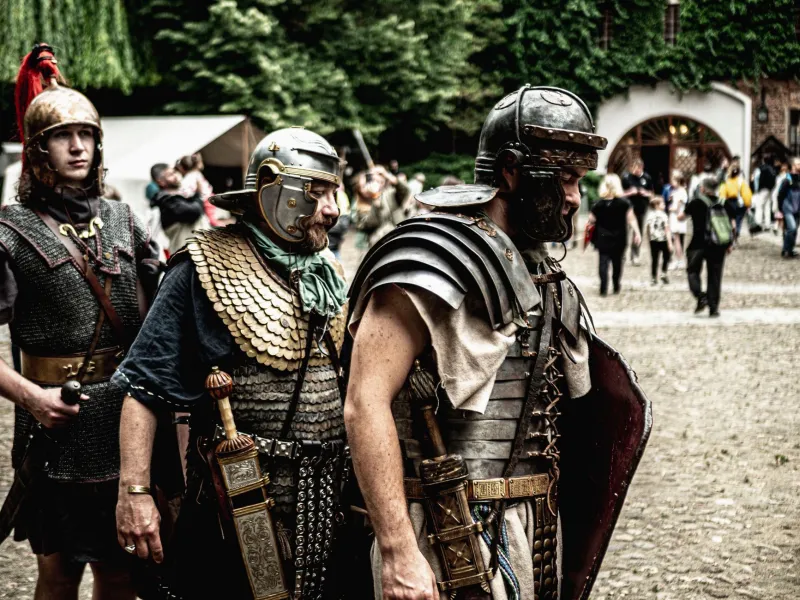
The soldiers of the mid-to-late Republic served for years, sometimes decades, in distant campaigns. The land they had left — the small farms that were the economic foundation of Roman citizenship — was frequently absorbed by wealthy landowners during their absence. The Gracchi brothers attempted in the second century BCE to address this dispossession through land reform. Both were killed for their efforts. The fundamental problem remained.
What filled the vacuum was personal loyalty. When the state could not or would not honor its obligations to veterans, individual commanders did. Gaius Marius restructured the Roman army in 107 BCE, opening it to landless citizens and — critically — making veterans dependent on their general rather than the state for their post-service settlement. The soldiers who followed Sulla, Caesar, and ultimately Augustus into civil war were not acting irrationally. They were following the only institution that had ever reliably kept its promises to them.
The Republic did not fall because of military ambition alone. It fell because it had systematically broken faith with the men who defended it until those men had nowhere to direct their loyalty except toward individual commanders willing to offer what the state would not. The lesson has been available for two thousand years.
The Mesopotamian and Egyptian Records
The Roman case is the most elaborately documented, but it is not the earliest. Mesopotamian texts from the third millennium BCE contain records of land grants made to soldiers, disputes over those grants, and petitions from veterans whose allocations had been seized or encumbered during their service. The bureaucratic apparatus of the Egyptian New Kingdom included formal systems for veteran resettlement — systems whose existence implies that informal arrangements had previously failed often enough to require institutionalization.
What these records collectively suggest is that the returning soldier problem appeared as soon as states became sophisticated enough to project military force beyond their immediate borders. The psychological and economic dynamics involved do not require modern conditions to operate. They require only human beings who have been placed in extreme circumstances, promised compensation, and then returned to a society that made those promises in a different political moment.
The Bonus Army and the American Pattern
In the summer of 1932, approximately seventeen thousand veterans of the First World War converged on Washington, D.C. They had been promised a bonus — a deferred payment for their wartime service — scheduled to be paid in 1945. In the depths of the Great Depression, with unemployment near twenty-five percent, many of these men wanted the payment early. They established camps across the Anacostia Flats and waited.
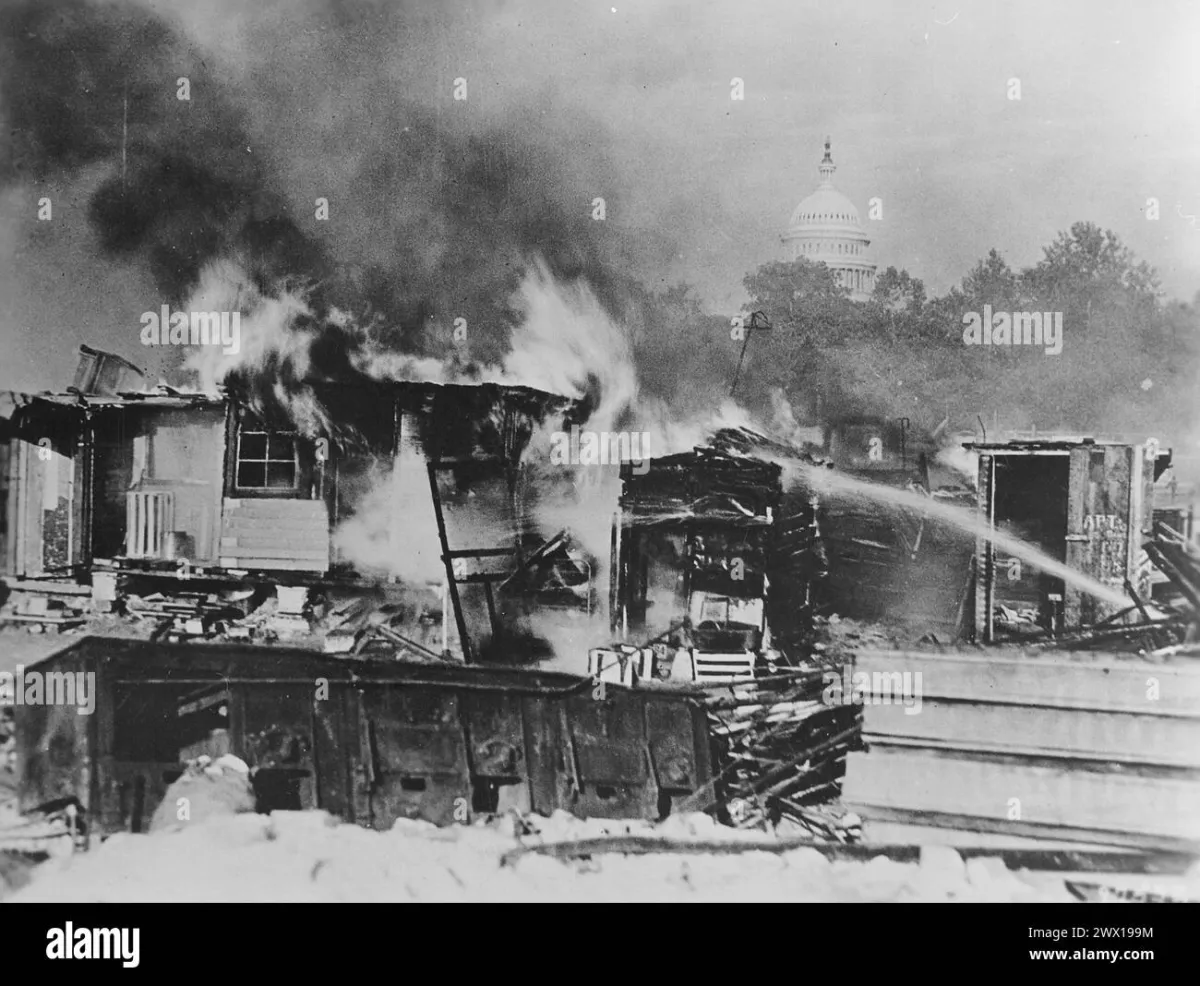 Photo: Anacostia Flats, via c8.alamy.com
 Photo: Washington, D.C., via media.tacdn.com
President Hoover ordered their removal. General Douglas MacArthur, with Major Dwight Eisenhower at his side and Major George Patton commanding cavalry, dispersed the encampment with tear gas and bayonets. The optics were, by any reasonable assessment, catastrophic: the Army of the United States attacking veterans of the United States Army on the grounds of the nation's capital.
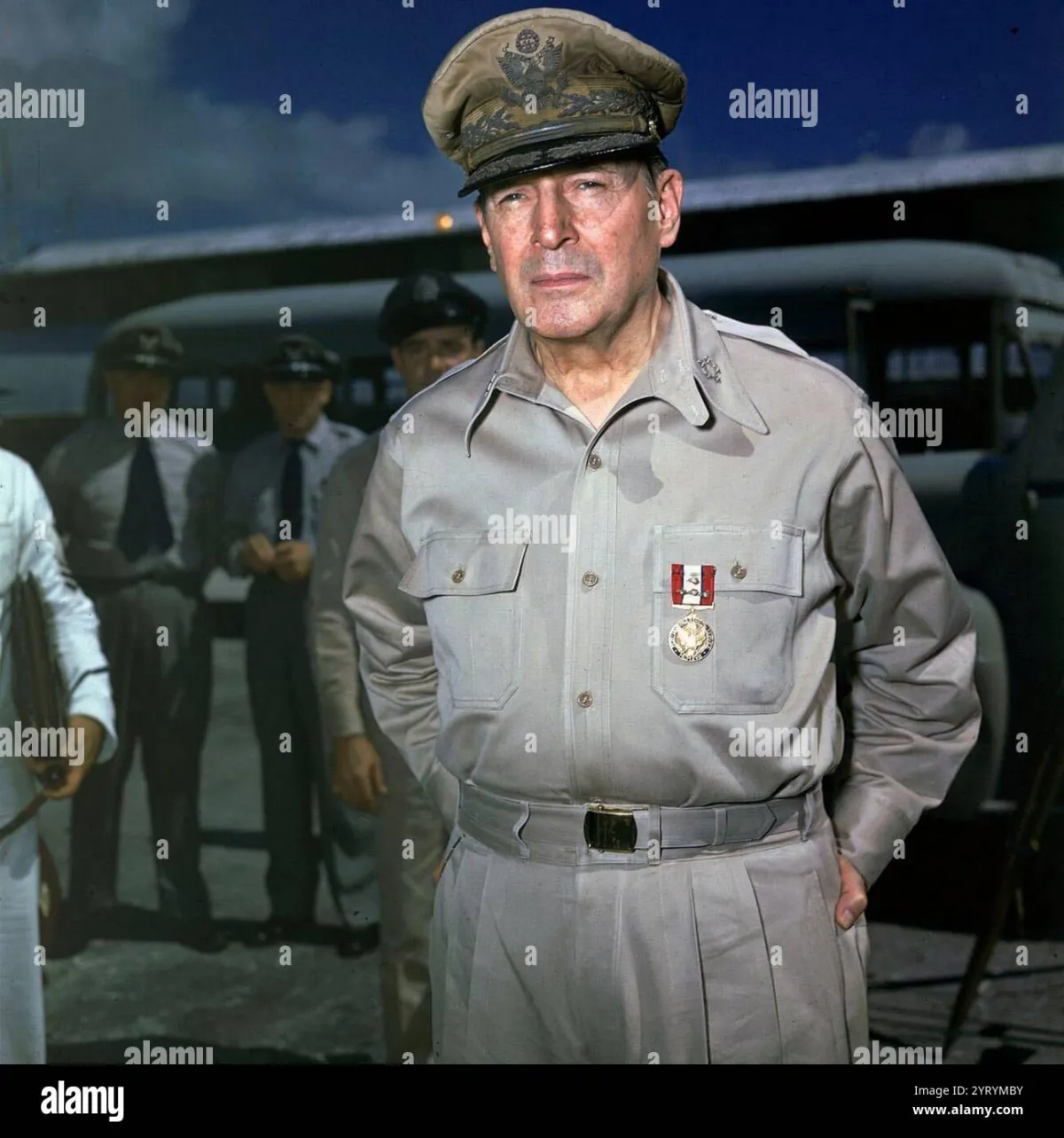 Photo: General Douglas MacArthur, via c8.alamy.com
The episode was not an aberration. It was consistent with a pattern that had already played out after the Civil War, when veterans on both sides returned to find their economic circumstances substantially unchanged or worsened, and after the Revolutionary War, when soldiers who had been paid in nearly worthless Continental currency found that speculators had purchased their claims for pennies before the new federal government made good on them.
After the Second World War, the G.I. Bill represented the most serious American attempt to break this pattern. The results — in educational attainment, homeownership, and economic mobility — were substantial and measurable. The pattern broke, at least partially, when the political will to honor the commitment was sustained long enough to produce structural change. That political will has rarely been sustained.
What the Diagnostic Reveals
Human psychology has not changed. The soldier who returns from a distant war carries the same psychological weight that Roman legionnaires carried, that Akkadian infantrymen carried, that doughboys carried home from the Argonne. The experience of sustained mortal threat, of institutional dependence, of separation from civilian rhythms — these produce predictable effects that are well-documented across the entire available record.
What changes is not the veteran. What changes is the society's willingness to acknowledge what it asked of him and to honor what it promised in return. And that willingness, the historical record suggests, is directly correlated with how recently the society needed something from those soldiers.
The political urgency of veteran welfare tends to peak at the moment of discharge and decline steadily thereafter. This is also not a modern phenomenon. Roman senators who had enthusiastically voted for the wars that enriched them were notably less enthusiastic about the land reforms that would have compensated the men who fought them. The British government that celebrated the heroes of the Crimea was the same government that left many of those men to beg in the streets of London within a decade.
A Diagnostic, Not a Policy Question
The treatment of veterans is often framed in American public discourse as a policy debate: how much funding for the Department of Veterans Affairs, how to reduce wait times, how to address the epidemic of veteran suicide, which currently claims an estimated twenty-two lives per day. These are legitimate policy questions. But the historical record suggests they are downstream of a more fundamental question.
The societies that have treated their veterans well have done so because those societies had a coherent and honest account of what they were asking those veterans to do and why. The societies that have treated their veterans badly have generally done so because the wars those veterans fought were easier to celebrate in the abstract than to justify in the particular — and the veteran, with his specific wounds and his specific claims, makes the particular unavoidable.
The five-thousand-year record is available. What it shows is not complicated. A civilization that cannot look its veterans in the face is a civilization that cannot look at itself honestly. That is not a policy problem. It is a diagnostic one.