The Mathematics of Separation: Why Independence Movements Calculate Wrong

The Eternal Appeal
In 411 BCE, the island of Euboea declared independence from the Athenian League, convinced that freedom from Athenian tribute and trade restrictions would bring immediate prosperity. Within three years, Euboean cities were begging to rejoin the alliance they had abandoned, their independence having delivered economic isolation rather than economic liberation. The pattern—initial enthusiasm for separation followed by harsh confrontation with practical realities—has repeated across every continent and every century since records began.
Modern political science analyzes secession through contemporary frameworks, but five thousand years of recorded history reveal that human psychology drives independence movements toward the same calculations and the same miscalculations regardless of era or culture.
The Grievance Accumulation
Secession movements begin with legitimate grievances that follow predictable patterns. The central authority extracts resources—taxes, tribute, military service, or trade concessions—while providing benefits that seem inadequate compensation. Regional elites calculate that independence would eliminate extraction while preserving benefits through alternative arrangements.
This calculation appears logical until implementation begins. The benefits provided by central authority—military protection, trade networks, currency stability, legal frameworks—often depend on scale economies that smaller independent units cannot replicate. The costs of extraction, while visible and resented, frequently represent efficient sharing of expenses that become much larger when borne independently.
Consider the fragmentation of Charlemagne's empire after 843 CE. The Treaty of Verdun divided Frankish territories among three heirs, each convinced they could maintain imperial benefits while eliminating the costs of supporting distant territories. Within generations, each fragment faced military threats they could no longer repel, trade disruptions they could not resolve, and administrative costs they could not afford. The empire's scale had provided efficiencies that its fragments could not reproduce.
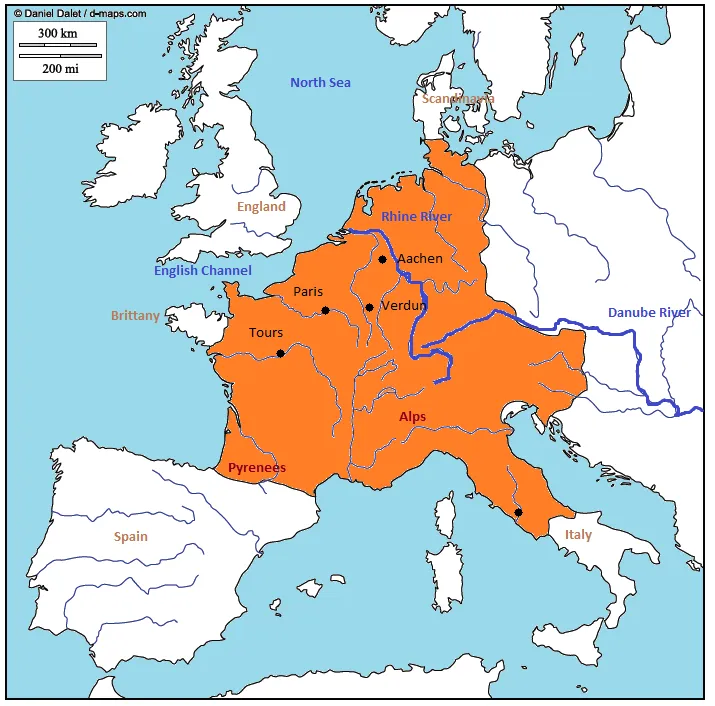 Photo: Charlemagne's empire, via mrtbms.weebly.com
The Network Effect
Successful political and economic systems create network effects that benefit all participants but become invisible until disrupted. Citizens of prosperous regions often assume their success stems from local advantages rather than their position within larger networks that amplify those advantages.
The Hanseatic League illustrates both the power of networks and the costs of abandoning them. When Lübeck and other Baltic cities formed their commercial alliance in the twelfth century, member cities gained access to trade networks, legal protections, and collective military defense that no single city could provide independently. However, as individual cities grew wealthy through league membership, local merchants began to resent profit-sharing requirements and restrictions on independent action.
 Photo: Hanseatic League, via 64.media.tumblr.com
By the sixteenth century, several major cities had withdrawn from the league, convinced they could maintain their commercial advantages while eliminating league obligations. The result was predictable: isolated cities lost access to the trade networks that had created their wealth, while the remaining league members lacked the critical mass to maintain collective benefits. Both separatists and loyalists ended up worse off than they had been within the original system.
The Sovereignty Illusion
Independence movements consistently overestimate the practical value of sovereignty while underestimating its costs. Political control feels valuable—and often is valuable—but exercising that control requires resources and capabilities that may exceed what newly independent entities can generate.
The dissolution of the Soviet Union provides a natural experiment in secession economics. Baltic states, with strong institutional foundations and geographic advantages, successfully transitioned to independence and eventually achieved higher living standards than they had enjoyed as Soviet republics. However, Central Asian republics, lacking those advantages, found that independence brought economic disruption, institutional collapse, and authoritarian governance that often exceeded Soviet-era restrictions.
The difference lay not in the desire for independence—which was equally strong across all regions—but in the practical capacity to replace the benefits that union membership had provided. Successful secession requires not just the ability to eliminate unwanted obligations but the capacity to recreate essential functions independently or through alternative partnerships.
The Transaction Cost Reality
Economic integration reduces transaction costs through common currencies, legal frameworks, and regulatory standards. Independence movements often underestimate how much these integrated systems reduce the costs of economic activity, focusing instead on the visible costs of maintaining integration.
Brexit provides a contemporary example of this miscalculation. Supporters correctly identified costs of EU membership—regulatory compliance, budget contributions, and constraints on independent policy—while systematically underestimating the transaction cost increases that would result from leaving integrated European markets. The assumption that Britain could maintain the benefits of integration while eliminating its costs proved incorrect, as the economics of trade depend on standardization and coordination that require ongoing institutional commitment.
Similar patterns emerge throughout history. When regions calculate the benefits of independence, they typically focus on eliminating visible costs while assuming invisible benefits will continue through alternative arrangements. This calculation error appears across cultures and centuries because human psychology naturally focuses on immediate, visible costs while discounting complex, indirect benefits.
The Scale Economics Trap
Many functions of government and commerce operate more efficiently at larger scales. Military defense, currency management, infrastructure development, and legal systems all benefit from economies of scale that smaller independent units struggle to replicate.
The fragmentation of Yugoslavia illustrates how secession can destroy scale economies that had benefited all participants. The Yugoslav federation, despite its political problems, had created integrated industrial supply chains, transportation networks, and financial systems that enabled economic development across all republics. Independence movements focused on eliminating political constraints and ethnic tensions while assuming economic integration could continue through voluntary cooperation.
The result was economic disruption that lasted decades. Supply chains collapsed, currency systems fragmented, and infrastructure investments became stranded assets. Each new nation faced the full costs of functions that had previously been shared across a larger population, while losing access to markets and resources that had been available within the federation.
The Timing Problem
Successful secession requires favorable timing that independence movements rarely control. Economic and political conditions must align to make independence both feasible and beneficial, but secession campaigns typically build momentum based on grievances rather than opportunities.
The American Revolution succeeded partly because Britain was simultaneously fighting global conflicts that limited its ability to suppress colonial rebellion. Had the same grievances emerged during peacetime, when Britain could have devoted full attention to maintaining colonial control, the outcome might have been different. Similarly, the successful independence of Baltic states occurred during Soviet collapse, when Moscow lacked the capacity to maintain control even if it had chosen to try.
Most secession attempts occur during periods of central government strength, when grievances are most visible but prospects for successful separation are lowest. This timing mismatch helps explain why independence movements with legitimate grievances so often fail to achieve their objectives.
The Persistent Pattern
Five thousand years of recorded history suggest that secession movements face consistent mathematical problems that transcend specific political or economic circumstances. The benefits of integration—scale economies, network effects, and reduced transaction costs—operate regardless of the political system that provides them. The costs of independence—lost efficiencies, increased expenses, and reduced access to larger markets—emerge regardless of the justification for separation.
This doesn't mean secession never succeeds or that independence movements are always wrong. But it does suggest that successful separation requires more than eliminating unwanted political relationships—it requires building alternative systems that can provide equivalent benefits at acceptable costs. Understanding this mathematical reality might help independence movements develop more realistic expectations and more effective strategies for achieving their objectives.