The Warrior Caste Problem: What Five Thousand Years of Professional Armies Tell Us About Who Bears the Cost of War
In the United States today, roughly one-half of one percent of the population serves in the active military. The country has been engaged in continuous overseas combat operations for more than two decades. The people making the decisions to sustain those operations represent, in almost every measurable demographic category, a population that is not fighting them.
This is not an accusation. It is a description of an arrangement. And the historical record has a great deal to say about how such arrangements tend to develop over time.
The Citizen-Soldier Ideal and Its Limits
The ancient Athenians built their military around the principle that the people who voted for war should be the people who fought it. The hoplite phalanx was not a professional force — it was a formation of property-owning citizens who purchased their own equipment and returned to their farms when the campaign ended. The connection between political decision-making and physical risk was direct and personal.
This arrangement had obvious military limitations. Citizen-soldiers needed to go home. They were not always available. They were not always willing. And as Athens grew more prosperous and its strategic ambitions expanded, the gap between what citizen militias could accomplish and what Athenian policy demanded became a persistent source of tension.
The solution Athens reached — hiring mercenaries, relying increasingly on allied contingents, developing a professional naval class of rowers drawn from the poorest citizens — was pragmatic and militarily effective. It was also, in retrospect, a structural transformation with consequences that reached far beyond the battlefield.
When the people who bear the physical cost of a war are no longer the same people who bear the political cost of voting for it, the calculus of decision-making changes in ways that are subtle at first and catastrophic later.
Rome's Lesson, Taught Slowly
No civilization has left a more detailed record of the warrior-caste problem than Rome. The transformation of the Roman military from a citizen levy to a professional force under Gaius Marius in the late second century BCE is one of the most consequential administrative decisions in the ancient world — and one of the most instructive.
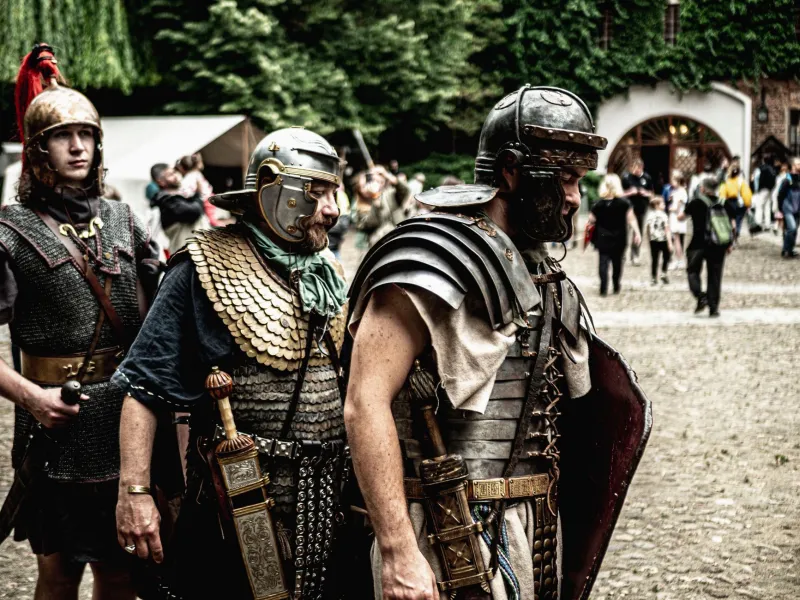
The Marian reforms solved an immediate problem. Rome needed soldiers it could deploy for extended periods across distant theaters. Citizen-farmers could not fill that role. Professional soldiers, recruited from the landless poor and bound to their commanders by salary and the promise of land grants upon discharge, could.
What the reforms also created was a military whose primary loyalty ran not to the Roman state in the abstract, but to the specific generals who paid them, led them, and secured their pensions. The legions that crossed the Rubicon with Julius Caesar were not defying Rome as an institution out of revolutionary conviction. They were following a commander to whom they were personally and economically bound, against other commanders to whom they had no comparable attachment.
The lesson Rome taught — across the better part of three centuries of increasingly frequent civil conflict — is that professional armies do not remain politically neutral by default. They remain politically neutral only so long as the state is capable of fulfilling its obligations to them and no individual commander offers a more attractive alternative. The moment that equilibrium breaks, the weapons point inward.
The Ottoman Janissaries and the Price of Insularity
The Ottoman Janissary corps represents perhaps the most complete historical study of what happens when a professional warrior class achieves sufficient insulation from civilian society. Recruited originally from Christian boys taken through the devshirme system, converted, educated, and raised entirely within military institutions, the Janissaries were designed to be loyal to the sultan alone — unattached to family networks, regional politics, or the economic interests of the broader population.
For roughly two centuries, the system worked as intended. The Janissaries were among the most effective military forces in the world, and their loyalty to the Ottoman dynasty was largely reliable.
Then the corps began to change. Janissaries were permitted to marry. Their sons were admitted to the corps. Economic privileges accumulated. The Janissaries developed commercial interests in Constantinople, invested in trade, and became a political constituency with specific demands. By the eighteenth century, they were less a military force than a hereditary guild with weapons — capable of deposing sultans who threatened their privileges and blocking modernization efforts that would have diminished their institutional relevance.
The corps was eventually dissolved in 1826, in an episode the Ottomans called the Auspicious Incident, at the cost of several thousand dead Janissaries and the destruction of their barracks. The reform came roughly a century after it was clearly necessary.
The Separation Problem in Modern Context
The contemporary United States did not set out to create a warrior caste. The all-volunteer military that replaced conscription in 1973 was a response to genuine and legitimate grievances about the equity of the draft system. The arguments for a professional military — higher skill levels, greater unit cohesion, improved retention of institutional knowledge — are real arguments, and the military produced by the volunteer system is by many technical measures the most capable in American history.
But the historical pattern does not care about intentions. It cares about structures.
When military service is concentrated in specific geographic regions, specific economic classes, and specific family networks — when the same surnames appear across multiple generations of enlistment records while other surnames never appear at all — the structural conditions that the historical record associates with long-term instability are present, regardless of how the arrangement was originally designed.
The experimental psychology literature on in-group and out-group dynamics, developed in university laboratories over the past half-century, consistently finds that groups which perceive themselves as bearing disproportionate costs for collective decisions develop predictable patterns of resentment, insularity, and political radicalization. The five-thousand-year record suggests the same thing, at far larger scale and with far more severe consequences.
What the Record Recommends
The historical record does not recommend any specific policy. It is not an op-ed. What it does is document, with considerable consistency, the downstream effects of allowing the distance between those who decide on war and those who fight it to grow too wide for too long.
Civilizations that maintained meaningful overlap between their decision-making classes and their fighting classes tended to make fewer wars, shorter wars, and wars with more clearly defined objectives. Civilizations that allowed that overlap to disappear tended, over time, to make more wars, longer wars, and wars whose objectives became progressively harder to articulate.
The mechanism is not mysterious. When the people in the room deciding whether to send soldiers have no soldiers in their families, the abstraction is easier to sustain. When the people carrying weapons have spent their entire adult lives in institutions that civilian society neither understands nor engages with, the abstraction runs in both directions.
The record has seen this movie before. It runs for a long time before it ends. But it does end.